On this page
- The one rule that governs everything
- Why running away is usually wrong
- Reading a crowd instead of tracking zombies
- Spacing and the two-second rule
- Resource management in survival games
- Building a run that lasts
- The geometry of getting cornered
- Reading crowd flow
- Survival without a weapon versus survival with one
- Building a survival routine
- The mental side of long runs
- One-hit survival versus health-bar survival
The one rule that governs everything
Never be in a position with only one way out.
That single sentence covers most of what separates long survival runs from short ones. Almost every survival death is preceded, three to five seconds earlier, by a moment where the player moved into a space that had exactly one exit — a corner, a wall, a gap between two approaching groups.
The death itself feels sudden and unlucky. It was neither. It was determined earlier, by a movement choice that felt safe because it increased the distance to the nearest threat while quietly removing options.
In survival games, distance is comfort and options are safety. They are not the same thing, and beginners consistently trade the second for the first.
Why running away is usually wrong
The instinctive response to an approaching zombie is to move directly away from it. This is almost always the worst available option, for a reason that is obvious once stated: moving directly away from something means moving directly toward whatever is behind you, which you are by definition not looking at.
The better move is to run past the threat at an angle. This feels dangerous — you are reducing the distance before increasing it — and it is dramatically safer, because it keeps you moving into space you can see and it puts the threat behind you where it can no longer constrain your options.
- Pick a gap, not a direction. Look for the space between two zombies rather than the space behind one.
- Commit early. A gap you enter decisively is safe; a gap you enter hesitantly closes while you hesitate.
- Cross diagonally. Diagonal movement across an arena preserves more escape options than movement along an edge.
Reading a crowd instead of tracking zombies
Early in a run you can track individual zombies. By ninety seconds into a dense survival game, you cannot — there are simply too many, and trying is what causes the tunnel vision that ends runs.
The transition every good survival player makes is from tracking objects to reading shapes. You stop asking 'where is that zombie going' and start asking 'where is the empty space, and which direction is it moving'. Crowds have flow, and flow is much easier to read than individual paths.
- Gaps open behind clusters, not in front of them. Aim for the space a group has just vacated.
- A crowd moving toward you from one side is a wall; the same crowd viewed from its edge is a series of gaps.
- When the field is dense, reduce your movement size. Large commitments in a crowd cannot be reversed.
This is also why panicking makes things worse in a specific mechanical way, not just a psychological one: panic causes large, fast movements, and large movements in a dense field remove exactly the fine positioning you need.
Spacing and the two-second rule
A useful heuristic borrowed from driving: maintain at least two seconds of separation from the nearest threat at all times.
Two seconds is roughly the time needed to notice a new threat, decide on a response and execute it. Less than that and you are reacting without deciding, which works occasionally and fails predictably. More than that and you are being too passive to collect pickups or control your position.
Practically, this means picking a landmark distance in each game and treating it as your minimum. In most of our arena games that distance is roughly a quarter of the screen width. Once you have internalised it, threat evaluation becomes almost automatic — anything inside the line is urgent, anything outside is not.
Resource management in survival games
Where survival games give you resources — a battery in Night Survivor, a pulse cooldown in Zombie Swarm, an infection meter in Infection Zone — they are all really the same thing: a timer with a visual dressing.
The mistake is treating them as savings. A resource you never spend has no value, and an escape tool held in reserve during a death is simply a tool you wasted. The correct framing is 'how many seconds does this buy me, and what am I doing with those seconds'.
Spend escape resources when you are already in trouble, not when you feel crowded. Feeling crowded is normal in survival games; being trapped is not, and that is what the tool is for.
Building a run that lasts
Long survival runs have a shape. The first thirty seconds are easy and should be used to establish position and take any free pickups. The next minute is the ramp, where difficulty climbs and mistakes are still recoverable. After roughly ninety seconds most well-tuned survival games plateau, and the remainder of the run is a test of whether you can hold a stable pattern without a lapse.
Knowing this shape changes how you play the opening. Players who play the first thirty seconds carefully are wasting the easiest part of the game; players who play it aggressively arrive at the ramp already positioned well.
It also explains the common experience of best runs clustering. Most players' times fall either well under a minute — they died during the ramp — or well over two minutes, because reaching the plateau means they had the habits to hold it.
The geometry of getting cornered
It is worth being precise about why corners kill, because 'do not get cornered' is advice everyone has heard and most people still ignore under pressure.
In open ground you have a full circle of escape directions. Against a wall you have half of one. In a corner you have a quarter. But the number of threats does not change — the same crowd is still coming, it simply now has fewer directions to cover.
That is the whole mechanism, and it explains why corners feel safe right up until they are fatal. Approaching a wall genuinely does reduce the directions threats can come from, which registers as relief. What it does not do is reduce their number, so the crowd simply concentrates in the remaining arc and closes it.
A wall removes threats from behind you and adds them to the only route out. That is a trade, and it is always a bad one.
The practical habit is to build a mental picture not of where threats are but of where you could go. If that picture has fewer than two clear answers, you are already in trouble regardless of how far away the nearest zombie is.
Reading crowd flow
Once density passes the point where you can track individuals, survival becomes a fluid-reading exercise. Crowds of chasing enemies have properties that are consistent across every game on this site.
Crowds have momentum
A group that has been chasing you toward the left of the arena cannot instantly reverse. When you cut back across their front, you are exploiting several seconds of committed movement. This is why direction changes are so much more valuable than speed.
Gaps open behind, not in front
The space a cluster has just left is the safest ground on the field, because everything in that cluster is now facing away from it. New players consistently aim for the space in front of a group, which is exactly where it is about to be.
Density is uneven and self-correcting
Chasing enemies bunch up because they all path to the same point. That bunching creates the gaps you need, and it means a very dense field is often easier to thread than a moderately dense one — the crowd has organised itself into clumps with space between them.
Edges concentrate crowds
When you move along a wall, the crowd behind you compresses into a smaller arc and becomes genuinely denser. The same crowd in open ground spreads out. This is a second, independent reason to avoid edges beyond the escape-route argument.
Survival without a weapon versus survival with one
Half the games in this category give you something to fight with and half do not, and the correct play differs more than you might expect.
| Unarmed (Zombie Rush, Zombie Swarm) | Armed (Last Survivor, Night Survivor) | |
|---|---|---|
| Primary skill | Continuous positioning | Positioning plus timing |
| Correct default | Keep moving, always | Move, then commit briefly |
| Main mistake | Fleeing in straight lines | Attacking when you should reposition |
| Crowd handling | Thread gaps | Shape the crowd, then clear an arc |
| Recovery | Impossible — one touch ends it | Possible, but health does not return |
The row that catches people out is 'main mistake'. Having a weapon creates an urge to use it, and in a survival game a swing or a shot that does not need to happen costs you the movement you would otherwise have made. In Last Survivor specifically, the long swing cooldown means an unnecessary attack is close to a full second of being unable to respond.
The correct framing for armed survival is that your weapon is for shaping the crowd, not for reducing it. You are not trying to clear the field; you are trying to remove the specific enemies that are closing your escape routes.
Building a survival routine
Long survival runs are surprisingly rhythmic. Players who reach the plateau consistently tend to settle into a repeating cycle rather than reacting continuously.
- Establish an orbit. A wide loop around the arena that stays away from the edges. This is your default state and you should return to it whenever nothing urgent is happening.
- Sweep on a schedule. Every eight to ten seconds, deliberately check the whole field rather than the part you are moving toward. This catches the threat that would otherwise arrive unannounced.
- Adjust, do not react. Small course corrections that keep the orbit clear, rather than large evasive movements once something is close.
- Break the orbit only deliberately. For a pickup you have decided is worth it, or to escape a genuine trap — never because you drifted.
- Re-establish immediately. After any break, get back into the orbit rather than continuing to improvise.
That cycle sounds mechanical, and it is. That is the point: a repeatable routine frees attention for the things that genuinely need it, which is precisely what fails when a player is improvising every second of a two-minute run.
The mental side of long runs
Survival games have an unusual failure mode: the longer a run goes, the more there is to lose, and the pressure of a personal best in sight measurably degrades play.
In our own testing, the last twenty seconds before a player's previous record is where a disproportionate number of runs end — not because difficulty spikes there, but because caution does. Players tighten up, make smaller and more hesitant movements, and lose the committed threading that got them that far.
- Do not watch the timer. Knowing you are near a record helps nothing and costs attention.
- Keep committing. The gap-threading that felt fine at thirty seconds is still correct at three minutes. Hesitation is what changed, not the game.
- Accept that the run will end. Every survival run ends. Playing to protect a run rather than to play it well is how good runs die early.
- Restart immediately. Sitting on a good result makes the next attempt worse, not better.
One-hit survival versus health-bar survival
Half the survival games here end on a single touch; the others give you a health bar. That difference changes correct play more than the enemy mix does, and players routinely carry the wrong instinct between them.
| One hit ends it | Health bar | |
|---|---|---|
| Games | Zombie Rush, Zombie Swarm, Night Survivor, Blackout Survival | Last Survivor, Infection Zone |
| Correct margin | Large — never be close to anything | Small — closeness is affordable |
| Gap threading | Only through gaps you are certain of | Aggressive threading is fine |
| Pickup detours | Almost never | Frequently worth it |
| Recovery | Impossible | Possible, but health rarely returns |
| What ends runs | One lapse in concentration | Accumulated small errors |
The practical consequence: in a one-hit game, your job is to never be in a position where a mistake is possible. In a health-bar game, your job is to spend a limited number of mistakes on things worth spending them on.
Players coming from health-bar games into one-hit games die early and repeatedly, because they thread gaps they would normally survive. Players going the other way play far too conservatively and never collect anything, which in Infection Zone specifically is a losing strategy — its scoring requires accepting risk.
Check which kind of game you are in before your first movement. It is stated on every game page, and it determines everything else.
Key takeaways
- Never occupy a position with only one exit. Most survival deaths are decided several seconds before they happen.
- Run past threats at an angle rather than directly away from them.
- Switch from tracking individual zombies to reading crowd shape as density rises.
- Keep roughly two seconds of separation from the nearest threat as a working minimum.
- Escape resources are timers, not savings. Spend them when trapped, not when uncomfortable.
- Walls halve your escape directions and corners quarter them without reducing the number of threats.
- Crowds have momentum and gaps open behind clusters — aim for the space a group has just left.
- With a weapon, attack to shape the crowd rather than to reduce it.
- A repeatable orbit-and-sweep routine frees attention for the decisions that actually need it.
- One-hit games ask you to make mistakes impossible; health-bar games ask you to spend a limited number of them well.
Frequently asked questions
Why do I keep dying at around the same time in every run?
Is it better to stay in the open or use the edges?
Should I collect every pickup?
How do I stop panicking when the screen fills up?
Is a denser field always harder?
Why do I play worse when I am close to my record?

Alex Morgan
Gaming Editor & Arcade Content Specialist
Alex Morgan is the editorial byline for everything published on Zombie Games Hub — game design notes, strategy guides and the tuning decisions behind all 30 arcade titles. More about our editorial byline.
Published · Last updated
Games mentioned in this guide
Zombie Rush
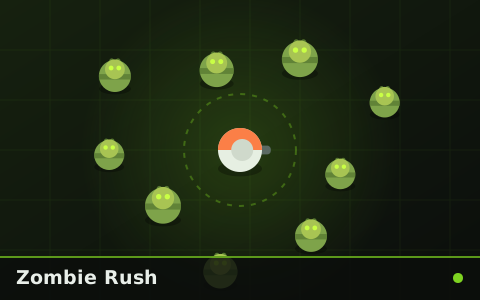
No weapon, no cover, no plan but movement. Zombies come from every edge and only get faster.

Last Survivor
A melee swing with a real cooldown, an arena with no exits, and waves that stop being survivable politely.

Zombie Swarm
Dozens of small, fast infected and one repel pulse on a cooldown. Crowd control, not marksmanship.
Night Survivor
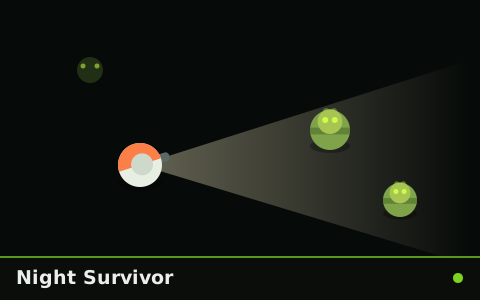
A torch beam, a draining battery and everything outside the cone is a guess.