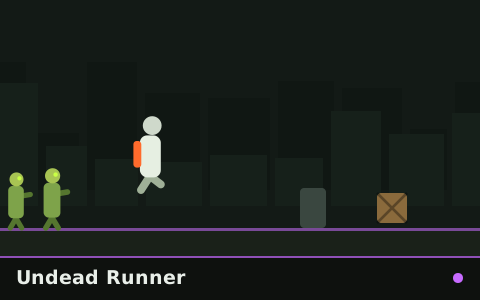


Why runners feel harder than they are
The difficulty in a runner is almost entirely perceptual. The obstacle pattern in front of you at three hundred metres is no more complex than the one at fifty metres — it simply arrives sooner. What actually changes is how much time you have to convert what you see into an input.
This is why looking further ahead is the single highest-value habit in the genre, and why players who stare at their character plateau early. Your character's position is already known to you. The information you need is at the far edge of the screen.
Lanes, gaps and commitment
Lane-based runners like Zombie Sprint and Zombie Highway reward early commitment. Moving to a clear lane before you strictly need to costs you nothing and removes an entire decision from your queue. Late lane changes are where runs die, because a late change under pressure has no margin for a mistimed input.
Free-movement runners like Zombie Tunnel work differently: there is no discrete lane to be safe in, so the correct habit is to hold the centre of the largest available gap and drift rather than jump.
Jump timing is a distance problem
Players who miss jumps are usually not pressing late — they are pressing based on how the obstacle looks rather than how far away it is. Every jump in our runners has a fixed arc and a fixed duration, which means there is exactly one correct distance at which to press, and it never changes even as the game speeds up.
Find that distance once, pick a visual landmark for it, and jump timing stops being a reaction and becomes a habit. That single change is usually worth several hundred metres.
Quick tips for zombie runner
- Watch the far edge of the screen, not your character.
- Change lanes early. A lane change you make with time to spare is free; a late one is a gamble.
- Learn the fixed jump distance once and use a visual landmark to trigger it.
- Slide under anything you can rather than jumping — slides recover faster than jumps.