On this page
Vision and attention
- Watch the far edge of the screen. Your character needs no attention; the information arrives at the opposite side.
- Use fullscreen. A larger image means earlier detection, which is free reaction time.
- Soften your focus. Staring at one point makes peripheral obstacles arrive late; a relaxed gaze covers more of the screen.
Timing
- Pick a landmark for jumps. Fixed arcs mean one correct distance, regardless of speed. Press when the obstacle crosses your marker.
- Learn separate timings for separate obstacle widths. Gaps need an earlier press than barriers.
- Do not hold the jump button unless the game has variable height. In Undead Runner it does nothing; in Rooftop Survivor it is the whole mechanic.
Lanes and commitment
- Commit early. An early lane change is free; a late one has no margin.
- Default to the centre lane. It has two escape options instead of one.
- One change per pattern. Double-taps under pressure are where runs end.
Recovery and pickups
- After a mistake, play conservatively for three seconds. Skip the next pickup, take the safest lane, make no optional inputs.
- Skip pickups that require leaving the safe line. The bonus rarely outweighs a mistimed jump.
- Prefer sliding to jumping where both work. Slides recover faster and preserve speed.
Session structure
Runners degrade with fatigue faster than any other category because they depend almost entirely on visual reaction. Two warm-up runs, then blocks of five or six attempts, then a break.
Stop when your distances drop rather than when you get frustrated — the drop reliably comes first, and pushing past it trains nothing.
Per-game specifics
The general advice applies everywhere; these are the details that only matter in one game each.
- Undead Runner: mistakes let the horde close rather than ending the run. Two errors in quick succession is the actual failure condition, so the three seconds after a mistake matter more than the mistake.
- Zombie Highway: zombies drift between lanes and wrecks do not. Identifying which you are looking at is the whole skill, and drifters are always the ones that catch you out.
- Zombie Sprint: patterns are finite and hand-built. Learning five of them is worth more than any amount of general practice.
- Rooftop Survivor: jump height is variable, so the landing roof matters more than the gap. A roof with a zombie near the edge needs a longer jump, not a safer short one.
- Zombie Tunnel: free movement means drifting rather than darting. Sharp corrections spend the margin you will need when the tunnel narrows.
Reading obstacle spacing
Beyond individual obstacles, spacing carries information that experienced runners use without thinking about it.
- Even spacing means rhythm. Once you find it, you can act on the beat rather than on each obstacle.
- A sudden gap usually precedes a cluster. Designers use breathing room to make the next difficult section readable. Use it to reset rather than relax.
- Tightening spacing is a warning. It means less recovery time between decisions, so pre-commit to positions earlier.
- A very wide gap is a good place to recover. After a mistake, this is where to settle your rhythm rather than to push for distance.
A ten-minute runner routine
Runners degrade with fatigue faster than anything else here, so a short structured session beats a long unstructured one by a wide margin.
- Two throwaway runs. Do not judge them. This is speed and scale calibration, and it genuinely matters in a genre where perception drives everything.
- One landmark run. Focus only on pressing at your visual marker, regardless of how it feels. Ignore distance.
- One far-edge run. Focus only on watching the far side of the screen. Ignore distance again.
- Three real attempts. Now play normally and record the best.
- Stop. If a fourth attempt is worse than your first, you are past your window and further play trains the wrong thing.
Roughly ten minutes, and most players post a better result in that session than in half an hour of continuous play.
Input habits that quietly cost distance
Beyond timing, a handful of input habits reduce results without ever feeling like mistakes, because none of them causes a death directly.
- Holding a direction after a lane change. The change has already resolved; continuing to hold does nothing except delay your next input.
- Double-tapping under pressure. Two lane changes when one was needed puts you somewhere you never chose. One change per pattern is nearly always correct.
- Jumping to feel safe. An unnecessary jump costs speed in games with a pursuing horde and costs reaction time in all of them, because you cannot act while airborne.
- Collecting reflexively. Pickups on the safe line are free; anything requiring a deviation is priced in risk, and after a mistake it is priced much higher.
- Watching the score. The distance counter updates constantly and reading it costs exactly the attention that should be at the far edge of the screen.
None of these will end a run on its own. Together they typically account for a noticeable fraction of the gap between an average session and a good one, which is why they are worth a deliberate session of attention.
Where exactly to look
'Watch the far edge' is the standard advice and it is slightly imprecise. Where you should look depends on the runner's axis, and getting it exactly right is worth more than getting it approximately right.
| Runner type | Look here | Not here |
|---|---|---|
| Side-scrolling (Undead Runner, Graveyard Escape) | Right edge, at ground height | Your character, or the sky |
| Top-down lanes (Zombie Sprint, Zombie Highway) | Top third of the screen, all lanes | Your own lane only |
| Free vertical (Zombie Tunnel) | Right edge, full height | The gap you are currently in |
| Platform (Rooftop Survivor) | The next landing surface | The gap between |
The lane-runner row is the one people get wrong most. Watching your own lane tells you when something is about to hit you; watching all lanes tells you which lane to be in, which is the decision the game is actually asking for.
The platform row matters too. In Rooftop Survivor the gap is not the problem — the landing is. Watching the gap produces jumps that clear it and land badly, which is the most common way that game ends.
One general technique: soften your focus rather than staring. A relaxed gaze covers more of the screen, and peripheral vision is genuinely good at detecting movement even though it is poor at detail. Staring at one point makes anything outside it arrive late.
Key takeaways
- Watch the far edge of the screen and use fullscreen for earlier detection.
- Jump timing is a fixed distance. Pick a landmark and use it regardless of speed.
- Commit to lane changes early, default to centre, and make one change per pattern.
- After a mistake, be deliberately conservative for a few seconds.
- Stop when distances drop, not when frustration hits.
- Each runner has one detail that dominates it — drift identification, pattern learning, or landing choice.
- Obstacle spacing carries information: a sudden gap usually precedes a cluster.
- Two calibration runs, two focus runs, three real attempts — then stop. Runners punish long sessions.
- Unnecessary inputs cost distance without ever causing a death, which is exactly why they persist.
- Watch all lanes rather than your own, and in platform runners watch the landing rather than the gap.
Frequently asked questions
Why do I fail the same obstacle repeatedly?
Are pickups worth collecting?
Which runner is hardest?
Should I learn one runner deeply or play all five?

Alex Morgan
Gaming Editor & Arcade Content Specialist
Alex Morgan is the editorial byline for everything published on Zombie Games Hub — game design notes, strategy guides and the tuning decisions behind all 30 arcade titles. More about our editorial byline.
Published · Last updated
Games mentioned in this guide
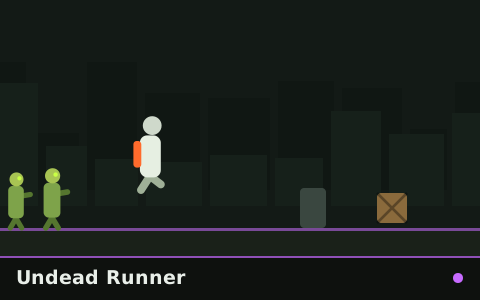
Undead Runner
Endless side-scrolling sprint. Jump, slide, grab supplies and keep ahead of a horde that never tires.

Zombie Sprint
Three lanes, no jumping, and obstacle patterns that arrive at the edge of what anyone can react to.

Zombie Highway
Four lanes of ruined highway, a fuel gauge and obstacles arriving faster than you would like.

Zombie Tunnel
No lanes. Free vertical movement through a service tunnel that keeps getting narrower.