On this page
Dodging happens before the dodge
The word suggests a last-second movement, and last-second movements are the least reliable thing in any arcade game. Real dodging is positional: you were never in the place where contact could occur, so no reaction was required.
This distinction matters because the two require completely different practice. Reactive dodging improves slowly and caps out at your reaction time. Positional dodging improves quickly and has no ceiling.
Angle running
The instinct when something approaches is to move directly away from it. In practice this is the worst available option: it walks you backwards into space you cannot see, and it keeps the threat at a constant bearing so it never actually loses you.
Run past instead. Move at roughly forty-five degrees to the approach, which reduces the distance briefly and then opens it rapidly while putting the threat behind you.
- It converts a chase into a pass, which resolves in about a second.
- It keeps you moving into visible space rather than blind space.
- It preserves escape options instead of spending them.
- It works identically against every pursuer type on the site.
Thread gaps, do not flee from bodies
As density rises, the safest space on the field is between two zombies rather than behind one. This is counterintuitive and reliably correct.
The reason is geometry. Behind a zombie is a shrinking pocket bounded by everything else approaching. Between two zombies is a corridor that stays open for as long as they are converging on where you were, not where you are going.
Commit fully when threading a gap. A gap entered decisively is safe; the same gap entered tentatively closes during the hesitation.
Know the contact radius
Every zombie has a contact radius, and it is usually slightly smaller than its visual footprint. Players who assume the visual is the hitbox leave more margin than necessary and spend movement they did not need to spend.
The practical takeaway is that passing close is safe, and safe passing is fast. In Zombie Dodge in particular, the difference between 'clearing a formation with room to spare' and 'clearing it precisely' is the difference between surviving one formation and surviving two overlapping ones.
Small movements under pressure
The most common failure when the field fills up is that movements get larger. Panic manifests physically as bigger inputs, and big inputs in a crowded field cannot be reversed.
The deliberate counter is to shorten your movements as density rises. It settles the panic and it improves your positioning at the same time, which is a rare combination.
The three-second rule
Almost every avoidable contact in a survival game is decided about three seconds before it happens. That is roughly how long it takes for a movement choice to close off the options you would have needed.
The practical version: when you are hit, do not ask what you should have done at the moment of contact. Ask what you were doing three seconds earlier. Almost always the answer is 'moving toward an edge', 'committing to a direction without checking behind me', or 'chasing a pickup into space I had not looked at'.
- At three seconds out you have a full range of options and no pressure. This is where the decision actually gets made.
- At one second out you have one or two options and are reacting.
- At contact you have none. Nothing you do here matters.
Players who improve at dodging are not reacting faster. They have moved their decision-making earlier, which feels like nothing is happening and produces dramatically better results.
Dodging different enemy behaviours
The correct evasion depends on how the thing chasing you actually works, and getting it backwards makes a solvable problem feel impossible.
| Behaviour | How to recognise it | Correct dodge |
|---|---|---|
| Direct pursuit | Swings wide behind you when you turn | Tight turns, cut close around obstacles |
| Drift | Never changes course for you | Judge relative velocity; pass behind it |
| Patrol | Repeats a fixed route | Time a crossing against a landmark |
| Formation | Arrives as a group with a shape | Move to where the shape will not be |
The drift case catches out the most people. A drifting enemy looks like it is reacting to you because it happens to be moving, but it is not — so the space behind its current heading is permanently safe, while the space in front of it is not, regardless of where you are.
Drills you can run in five minutes
Dodging improves fastest with constraints that force the correct habit rather than allowing it.
- The no-retreat drill. Play Zombie Rush with one rule: never move directly away from the nearest zombie. Always pass at an angle. Your first attempt will be short and your third will beat your normal average.
- The centre drill. Play a full run without entering the outer quarter of the arena. Uncomfortable, and it teaches how much space the middle actually has.
- The small-movement drill. Play with a self-imposed rule that no single movement lasts longer than about half a second. This forces the continuous correction style that works at high density.
- The observation drill. One run spent watching one enemy type and ignoring survival entirely. Deliberately die at the end.
Each takes one run. Doing all four takes about five minutes and reliably produces a better result than five minutes of ordinary play, because each one isolates a habit rather than exercising all of them at once.
Dodging with a weapon in hand
Everything above assumes you cannot fight back. When you can, dodging changes — and the change is smaller than most players assume.
- Positioning still does most of the work. A weapon removes threats one at a time; positioning handles all of them at once. The weapon is the supplement.
- Attacking costs mobility. Every shot or swing commits you to a facing and, in melee, to a recovery window. That cost is what makes unnecessary attacks expensive.
- Use the weapon to open routes, not to clear the field. The correct target is frequently the one blocking where you want to go rather than the one closest to hitting you.
- Disengaging is still available and still correct. Having a weapon makes it tempting to solve every situation by shooting, which is how players who came from shooters die in Last Survivor.
The mental model that works: your weapon is a tool for editing the geometry. It does not replace the need to be somewhere sensible — it lets you make somewhere sensible exist where it otherwise would not.
Which is why the movement habits in this guide transfer directly into the armed games rather than being replaced by them. Players who learn dodging in Zombie Rush arrive in the shooters with the harder half already done.
Key takeaways
- Positional dodging beats reactive dodging and improves much faster.
- Run past threats at roughly 45 degrees rather than directly away from them.
- The gap between two zombies is safer than the space behind one.
- Contact radii are smaller than they look — passing close is safe and fast.
- Shorten your movements as the field gets crowded, not lengthen them.
- Contact is decided about three seconds earlier — ask what you were doing then, not at the moment of the hit.
- Drifting enemies never react to you, so the space behind their heading is permanently safe.
- Constraint drills build dodging habits faster than ordinary play because they isolate one behaviour.
- A weapon edits the geometry rather than replacing positioning — the correct target is often the one blocking your route.
Frequently asked questions
Is there a dodge button in any of these games?
How close is too close?
Which game is best for practising this?
Why do I get hit by things I could clearly see?

Alex Morgan
Gaming Editor & Arcade Content Specialist
Alex Morgan is the editorial byline for everything published on Zombie Games Hub — game design notes, strategy guides and the tuning decisions behind all 30 arcade titles. More about our editorial byline.
Published · Last updated
Games mentioned in this guide
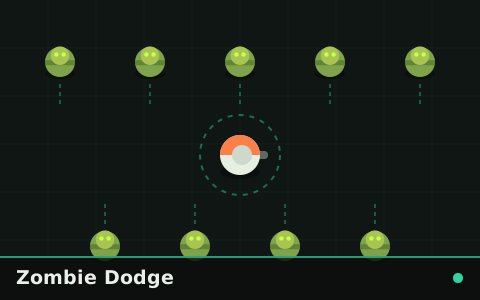
Zombie Dodge
One rule: do not get touched. Waves of zombies cross the screen in patterns you can learn.
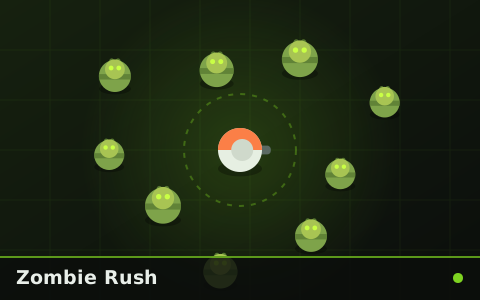
Zombie Rush
No weapon, no cover, no plan but movement. Zombies come from every edge and only get faster.

Zombie Swarm
Dozens of small, fast infected and one repel pulse on a cooldown. Crowd control, not marksmanship.

Infection Zone
Proximity infects you, not contact. Collect samples, then reach a safe zone before the meter fills.