On this page
- Five behaviours cover almost everything
- Direct pursuit is the most common and most learnable
- Drift is the one people misread
- Formations are patterns too
- How to learn a pattern deliberately
- Building a pattern vocabulary
- Patterns that combine
- Every behaviour on the site, catalogued
- Recognising your own patterns
Five behaviours cover almost everything
| Pattern | Behaviour | Weakness | Counter |
|---|---|---|---|
| Direct | Heads at your current position | Loses ground on every turn | Turn sharply and often |
| Predictive | Aims where you will be | Overcommits to your heading | Run straight, cut late |
| Patrol | Fixed route, ignores you | Fully predictable | Time crossings against a landmark |
| Zone | Guards an area, returns to it | Will not follow far | Cross the boundary and keep going |
| Drift | Moves on a fixed vector regardless of you | Never adapts | Read relative velocity, not position |
Nearly every enemy in every game on this site uses one of these. Once you can name the pattern, the counter is not something you work out under pressure — it is something you already know.
Direct pursuit is the most common and most learnable
Most zombies use direct pursuit: they head straight at wherever you currently are. This is why tight turns work so well and why straight-line running loses.
A direct pursuer must correct its heading every time you change direction, and correcting costs it distance. Zombie Chase is built entirely on this and is the best place to feel the effect clearly.
Drift is the one people misread
Drifting enemies move on a fixed vector regardless of where you are — the lane-changing zombies in Zombie Highway, the vertical drifters in Zombie Tunnel.
They are misread because they look like they are reacting to you when they are not. The correct reading is relative velocity: where will it be when I get there, given that it will not change course? Treating a drifter as a pursuer produces exactly the wrong avoidance.
Formations are patterns too
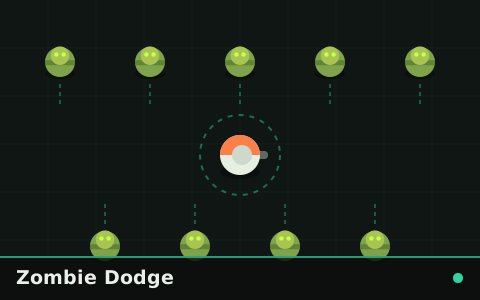
Zombie Dodge uses eleven hand-built formations, and recognising which one is arriving is worth more than reacting to its members individually.
The general principle applies everywhere: a group of enemies arriving together is usually a designed arrangement with a known safe response, not a random collection. Naming arrangements — 'the pincer', 'the sweep', 'the staircase' — makes them recallable at speed.
How to learn a pattern deliberately
- Spend one run observing. Do not try to survive; watch one enemy type and describe what it does.
- Name it. Named behaviours are recalled faster than described ones.
- Test the counter. Try the counter deliberately and see whether it works.
- Pre-commit. Once confirmed, the counter should cost no decision time.
Building a pattern vocabulary
Recognition is not passive — it can be trained deliberately, and the process is the same whether you are learning enemy behaviours or runner formations.
- Isolate. Spend one run watching a single enemy type and ignoring everything else. Deliberately die if necessary.
- Describe. Say what it does in one sentence. 'It heads straight at me and swings wide when I turn.'
- Name. One word. Naming converts a description into something retrievable at speed.
- Predict. Before it acts, say what it will do. Being wrong is the most useful outcome — it tells you the description is incomplete.
- Pre-commit the counter. Once the prediction is reliable, attach a fixed response so no decision time is spent.
Five to ten minutes per enemy type. There are only about eight distinct behaviours across the whole site, so the entire vocabulary is roughly an hour of deliberate attention.
Patterns that combine
Individual behaviours are easy. What actually kills runs is two patterns arriving at once, where the correct responses conflict.
| Combination | Conflict | Resolution |
|---|---|---|
| Direct pursuer + drifting obstacle | Turning is right for one and wrong for the other | Turn around the drifter, using it as an obstacle |
| Two formations overlapping | Two different safe positions | Find the compromise early rather than the ideal late |
| Patrol + timer | Waiting is right for one and wrong for the other | Price the wait in seconds; usually go |
| Fast + heavy together | Kill order versus positioning | Kill fast, kite heavy, never both at once |
The general resolution is to find a compromise position early rather than an optimal one late. A position that handles both patterns adequately beats a position that handles one perfectly, because the second pattern does not go away.
Every behaviour on the site, catalogued
The complete list, so the vocabulary is finite and learnable rather than open-ended.
| Behaviour | Where it appears | Counter |
|---|---|---|
| Direct pursuit | Most arena games, Zombie Chase | Turn sharply; cut close around obstacles |
| Objective pursuit | Defence games | Rank by distance to the objective |
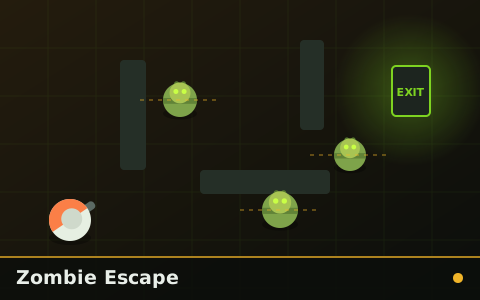
| Fixed patrol | Zombie Escape | Time a crossing against a landmark |
| Wander then pursue | Dead City Escape | Stay outside the notice radius |
| Lateral drift | Zombie Highway, Zombie Tunnel | Read relative velocity; pass behind |
| Formation sweep | Zombie Dodge | Move to where the shape will not be |
| Static obstacle | Runners, Zombie Sprint | Lane choice or jump timing |
| Approach timing | One-Tap Zombie | Identify type, then strike on the cue |
Eight behaviours across thirty games. That is a small enough vocabulary to learn deliberately in about an hour, and it covers every threat you will encounter here.
Recognising your own patterns
Enemy patterns get all the attention. Your own are just as consistent and considerably more expensive, because nobody is watching for them.
- Do you always circle the same direction? Most people do, without noticing. It is fine until an arena or a spawn pattern makes it wrong, at which point it becomes invisible and fatal.
- Do you drift to the same part of the arena? Almost everyone has a preferred quadrant. If your deaths cluster there, that is the finding.
- Do you engage or avoid under pressure? The instinct is consistent per player and it is right in one category and wrong in another.
- Do you check behind you on a rhythm, or only when reminded? Almost always the latter, and it is the most common source of damage from an unwatched direction.
- What do you do immediately after a mistake? Most people take a risk to recover, which is how single mistakes become pairs.
The way to find out is to spend one run watching yourself rather than the game. It feels strange and it produces a more useful finding than watching enemies does, because your own habits are present in every run regardless of what the game does.
Then apply the same method you would to an enemy pattern: name it, predict it, and deliberately do the opposite for a session. A habit you can name is one you can choose rather than one that chooses for you.
Key takeaways
- Five behaviours — direct, predictive, patrol, zone and drift — cover nearly every enemy here.
- Direct pursuers lose ground on every turn, so tight arcs beat straight lines.
- Drifting enemies never react to you; read relative velocity rather than treating them as chasers.
- Groups arriving together are usually designed formations with a known safe response.
- Spend one run observing rather than surviving — it is the fastest way to learn a pattern.
- There are only about eight distinct enemy behaviours across the site — roughly an hour to learn them all.
- Overlapping patterns need a compromise position found early, not an optimal one found late.
- Eight behaviours cover all thirty games — a vocabulary small enough to learn deliberately in about an hour.
- Your own habits are as consistent as any enemy pattern and nobody is watching for them — spend one run observing yourself.
Frequently asked questions
How do I tell direct from predictive pursuit?
Do patrols ever notice me?
Are formations random?
Is it worth dying deliberately to study something?

Alex Morgan
Gaming Editor & Arcade Content Specialist
Alex Morgan is the editorial byline for everything published on Zombie Games Hub — game design notes, strategy guides and the tuning decisions behind all 30 arcade titles. More about our editorial byline.
Published · Last updated
Games mentioned in this guide

Zombie Chase
One zombie. It never stops, never loses you, and gets faster every checkpoint you reach.
Zombie Escape
Find the exit, avoid the patrols, do not take the obvious route. Levels get denser, not bigger.

Zombie Highway
Four lanes of ruined highway, a fuel gauge and obstacles arriving faster than you would like.
Zombie Dodge
One rule: do not get touched. Waves of zombies cross the screen in patterns you can learn.