On this page
- Escape games measure planning, not reflexes
- Scouting: the two seconds that decide the run
- Commit fully or do not start
- Reading pursuers
- Spending a timer
- Exploration under pressure
- Route quality, measured
- Patrol timing as a discipline
- Pursuit mechanics in depth
- Exploration under a clock
- Timed escapes: spending a budget
- A route, walked through
Escape games measure planning, not reflexes
The defining property of the escape category is that there is a correct answer. A route exists that reaches the exit safely, and your job is to find it and execute it. That is a fundamentally different task from surviving indefinitely.
It also means that the best runs look unhurried. A player reacting to threats one at a time is playing a survival game inside an escape game and will be slower and less safe than someone who committed to a good line thirty metres ago and never needed to react at all.
Scouting: the two seconds that decide the run
Before moving in an escape game, look. Two seconds of observation regularly saves ten seconds of backtracking, and in games with patrolling enemies it is the difference between reading a cycle and guessing at one.
- Find the exit first. Even if you cannot reach it yet, knowing its direction shapes every subsequent choice.
- Identify the patrol cycles. Watch one full loop of the nearest patrol before committing to a corridor.
- Pick a landmark to time against. 'When it reaches that crate, I go' is reliable; eyeballing is not.
- Choose a line, not a direction. Know your next two moves before making the first.
Commit fully or do not start
Hesitation mid-corridor is the most common cause of escape failures. A corridor entered decisively is usually safe; the same corridor entered tentatively takes longer to cross, which is exactly the variable the patrol timing depended on.
The rule is binary: either the route is safe enough to commit to, or you do not enter it. There is no useful middle position, because a partial commitment gives you the risk of entering and none of the speed that made it safe.
If you find yourself frequently reversing mid-route, the problem is at the scouting stage. You are committing before you have enough information, then discovering it halfway.
Reading pursuers
Escape games use two kinds of pursuit, and the correct counter to each is the opposite of the other. Getting this backwards makes a learnable game feel impossible.
| Pursuit type | Behaviour | Weakness | Counter |
|---|---|---|---|
| Direct | Always heads at your current position | Loses ground on every turn | Turn sharply and often; cut close around obstacles |
| Predictive | Aims where you will be | Overcommits to your heading | Run straight, then cut late and sharply |
| Patrol | Fixed route, ignores you | Completely predictable | Time your crossing against a landmark |
| Zone | Guards an area, returns to it | Will not follow far | Cross the edge and keep going |
Zombie Chase uses direct pursuit exclusively, which is why tight turning works so well in it and straight-line running does not. Every game on this site states its pursuit type in the instructions, because guessing wrong is frustration rather than challenge.
Spending a timer
In timed escape games the countdown is a budget, not a threat. Treating it as a threat produces panic movement into unscouted space, which is the worst possible use of the remaining seconds.
- Price every route in seconds. A four-second detour around a zombie is worse than a two-second squeeze past it if you have the margin.
- Spend slack on safety. If you are ahead of the clock, take the safer line. Being early is only useful if you arrive.
- Below five seconds, take the direct line. Caution has stopped being affordable and hedging just loses.
- Never stop to think. Think while moving toward the objective you are confident about.
Exploration under pressure
Games like Dead City Escape add a second problem: you do not know where you are going. Exploration and safety pull directly against each other, since every new area revealed is also further from the ground you know.
- Explore in a spiral, not a straight line. Spirals keep your return route short at every point.
- Note the exit the moment you find it, even before you have what you need to use it.
- Assume cleared areas will refill. In most games density is tied to elapsed time, so the route home will be worse than the route out.
- Do not wait out a blocked route. Waiting costs the one resource that never stops draining.
Route quality, measured
'Pick a better route' is the whole category in four words, but it is worth being concrete about what makes one route better than another. Four properties, roughly in order of importance.
- Number of committed decisions. Every point where you must react is a point where you can fail. A route with two decisions is more reliable than a shorter route with six.
- Escape options along the way. A corridor with a side exit halfway is dramatically safer than a corridor without one, even if it is slightly longer.
- Visibility. A route that shows you the next section before you commit to it is worth several seconds of detour.
- Length. Last, and it surprises people. Raw distance is the least important of the four in every escape game on this site.
The reason length ranks last is compounding. A short cluttered route with six decision points fails whenever any one of them goes wrong. A longer clean route with two fails half as often, and the time saved by the short route is usually a second or two.
Count decisions, not metres. The route with fewer things that can go wrong wins even when it looks slower.
Patrol timing as a discipline
Games with patrolling enemies — Zombie Escape most directly — reward a specific and learnable technique that most players never develop.
- Watch one full cycle. Not a glance: an entire out-and-back. This takes two or three seconds and tells you the period, which is the only number you need.
- Pick a landmark for the trigger. 'When it reaches that crate, I go.' An object, not a feeling.
- Cross behind, not in front. The space a patrol has just left is safe for the whole of its outbound leg. The space in front of it is safe for a fraction of that.
- Commit fully. A crossing timed against a landmark and executed decisively is reliable. The same crossing done hesitantly takes longer than the gap.
- Chain crossings on the same beat. Two patrols on similar periods produce a rhythm you can ride through several corridors at once.
If you frequently reverse mid-corridor, the fault is at the scouting stage rather than the execution stage — you committed before you had the period.
Pursuit mechanics in depth
Direct pursuit is the most common enemy behaviour in the genre and it has an exploitable geometry that is worth understanding properly rather than as a rule of thumb.
A direct pursuer always heads at your current position. When you turn, its heading is now wrong, and it must travel along an arc to correct. The distance it loses on each turn scales with how sharply you turned and how close it was — tight turns at close range cost it the most.
- The pursuit curve is a spiral. If you circle at constant radius, a direct pursuer spirals inward but never on the shortest path.
- Corners are your friend here. Cutting close around an obstacle forces a wide correction; the pursuer takes the outside line every time.
- Reversing is the strongest single move. Counter-intuitive, and it forces a full 180-degree correction — the maximum possible loss.
- Straight lines are the worst option. Against something faster than you, a straight line is simply a countdown.
Zombie Chase is built entirely on this. Its pursuer eventually outruns you outright, and the whole late game is about how much distance you can make it spend on corrections.
Exploration under a clock
Dead City Escape combines routing with the problem of not knowing where you are going, which changes the priorities substantially.
Explore in a spiral
A spiral outward from your start keeps your return route short at every point. A straight-line exploration maximises the distance home at exactly the moment density is highest.
Note everything, immediately
The exit's position matters even before you can use it. So does the widest street, the densest block and the position of the first keycard — because keycards never spawn close together, finding one tells you where the other is not.
Assume the way back is worse
Density rises with elapsed time, not with distance explored. Every route you took outbound will be more crowded on the return. Plan the return trip while the streets are still thin.
Never wait
Waiting for a blocked route to clear is the one action that is always wrong here, because the resource you are spending — time — is the one that makes everything worse.
Timed escapes: spending a budget
In Emergency Escape the clock is deliberately insufficient, which converts every routing decision into an explicit price.
| Situation | Cost | Correct call |
|---|---|---|
| Zombie in a corridor, 4s detour available | 4s | Detour if you have more than ~6s of slack |
| Zombie in the open, 2s squeeze past | 2s + risk | Squeeze — contact costs 5s, and it is not certain |
| Checkpoint 3s off the direct line | 3s, returns 15s | Always take it |
| Pickup 5s off route with no time value | 5s | Never |
| Under 5s remaining | — | Direct line, accept contact |
The last row is the one people get wrong. Below about five seconds, caution stops being affordable: a five-second contact penalty and a five-second detour cost the same, but only one of them is certain to happen.
A route, walked through
A concrete example, because routing advice is hard to apply from principles alone. Picture a typical Zombie Escape level: you start on the left, the exit glows on the right, and between them are two vertical walls and three patrols.
- Do not move. Two seconds of looking. Where is the exit, which corridor is widest, and how many patrols cross the line you are considering?
- Reject the direct route. It crosses all three patrols. Three commitment points means three chances to fail, and the time saved is perhaps a second.
- Find the two-patrol route. Usually a detour along the top or bottom edge of the level. Longer, and it halves the number of things that can go wrong.
- Watch one full cycle of the first patrol. Note its period and pick a landmark — a crate, a wall corner — to trigger on.
- Cross behind it, decisively. The space it has just left is safe for its whole outbound leg.
- Re-read before the second crossing. Your timing relative to patrol two has changed now that you have moved. Do not assume the plan from the start line still holds.
- Take the last stretch at the same attention. The final corridor before an exit is where a disproportionate number of runs end, for the same reason the clear phase of a wave is dangerous.
Notice what is absent: any reaction. A well-routed escape contains almost no moments where you respond to something. If your runs are full of dodging, the routing is doing too little of the work.
Key takeaways
- Escape games have a correct answer. Finding it beats reacting well.
- Two seconds of scouting regularly saves ten seconds of backtracking.
- Commit fully to a route or do not enter it. Hesitation is the main failure mode.
- Turn sharply against direct pursuers; run straight and cut late against predictive ones.
- A countdown is a budget to spend on safety, not a reason to panic.
- Count decisions rather than metres — a longer route with fewer commitment points is more reliable.
- Watch a full patrol cycle, trigger on a landmark, and cross behind rather than in front.
- Direct pursuers lose the most ground on sharp, close turns; reversing is the single strongest move.
- In timed escapes, price every option in seconds and abandon caution below about five seconds remaining.
- A well-routed escape contains almost no reactions — frequent dodging means the routing is doing too little.
Frequently asked questions
Is it better to be fast or careful in escape games?
How do I beat a pursuer that is faster than me?
Should I collect pickups during an escape?
Why do I get caught in the same corridor repeatedly?
Is it ever right to wait in an escape game?
How do I know which pursuit type a game uses?

Alex Morgan
Gaming Editor & Arcade Content Specialist
Alex Morgan is the editorial byline for everything published on Zombie Games Hub — game design notes, strategy guides and the tuning decisions behind all 30 arcade titles. More about our editorial byline.
Published · Last updated
Games mentioned in this guide
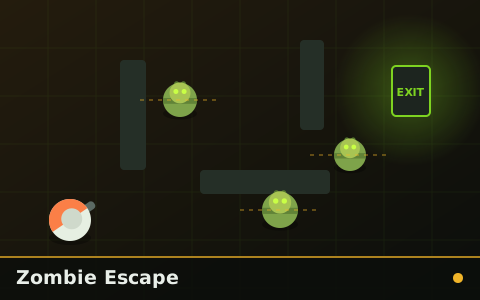
Zombie Escape
Find the exit, avoid the patrols, do not take the obvious route. Levels get denser, not bigger.

Dead City Escape
A city block you cannot see all of, two keycards you have to find, and one exit that only opens with both.
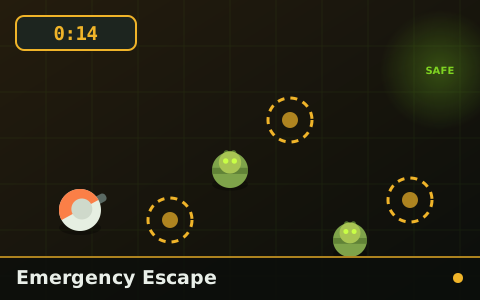
Emergency Escape
A countdown that only checkpoints can extend. Reach the safe zone or run out of clock trying.

Zombie Chase
One zombie. It never stops, never loses you, and gets faster every checkpoint you reach.