On this page
Before you move
- Locate the exit first, even if you cannot reach it yet. Its direction shapes every later choice.
- Watch one full patrol cycle before committing to a corridor. Two seconds of observation saves ten of backtracking.
- Pick a landmark to time against. 'When it reaches that crate' is repeatable; eyeballing is not.
While moving
- Commit fully or do not enter. Hesitation mid-corridor is the primary failure mode in the category.
- Know your next two moves, not just your current one.
- Move between patrols, not around them. The space a zombie has just vacated is the safest on the map.
Under a timer
- Price every route in seconds. A four-second detour is worse than a two-second squeeze if you have the margin.
- Spend slack on safety. Being ahead of the clock is only useful if you arrive.
- Below five seconds, take the direct line. Caution has stopped being affordable.
When exploring
In Dead City Escape you also have to find the exit. Explore in a spiral rather than a straight line — spirals keep your return route short at every point — and note the exit the moment you reveal it, even before you can use it.
Assume everywhere you cleared will refill. Density is tied to elapsed time, so the journey home is always worse than the journey out.
Failure is cheap here
Most escape games on this site restart the current level rather than the whole run, which makes experimentation genuinely cheap. Use it: try the route you are unsure about rather than the safe one you already know, because the information is worth more than the attempt.
Reading a level before you move
Escape levels are static for the first few seconds, which is an information advantage most players give away by starting immediately.
- Find the exit. Even if it is locked, its direction shapes everything else.
- Find the widest corridor. Usually the safest route, and rarely the shortest.
- Count the patrols on your intended line. More than two and the line is probably wrong.
- Pick your first landmark. The object you will time your first crossing against.
- Decide your first two moves. Not the whole route — just enough that you are executing rather than improvising.
That takes about three seconds and it is the single highest-return habit in the category.
The failure modes, and what each one means
| How you failed | Actual cause | Fix |
|---|---|---|
| Caught mid-corridor | Entered on the wrong half of a patrol cycle | Watch a full cycle before committing |
| Reversed and got caught | Committed before scouting | Decide at the entrance, not halfway |
| Ran out of time | Detoured too often | Price routes in seconds |
| Caught near the exit | Relaxed on the final stretch | The last corridor needs the same attention |
| Never found the objective | Explored in a line rather than a spiral | Spiral keeps the return route short |
The fourth row is worth flagging: the final stretch before an exit is where a disproportionate number of escape runs end, for the same reason the clear phase of a wave is dangerous. Success looks close, concentration drops, and the last patrol does not care.
Escape games ranked by what they demand
The five escape games test genuinely different things, so picking the right one for what you want to practise matters.
| Game | Demands | Play it to learn |
|---|---|---|
| Zombie Escape | Patrol timing | Reading cycles and committing |
| Graveyard Escape | Fixed-timing jumps | Landmark discipline |
| Dead City Escape | Exploration under rising pressure | Route shape and memory |
| Emergency Escape | Pricing detours in seconds | Budget thinking |
| Zombie Chase | Pursuit geometry | Turning as a defensive tool |
Played in that order they build on each other reasonably well: timing, then execution, then planning, then budgeting, then evasion. The last is the hardest and benefits most from the others.
Escaping under pursuit versus under patrol
The two situations demand nearly opposite behaviour, and mixing them up is the most common reason an escape run feels unfair.
| Under patrol | Under pursuit | |
|---|---|---|
| Threat behaviour | Fixed route, ignores you | Follows you continuously |
| Waiting | Often correct — cycles repeat | Always wrong — it closes distance |
| Route shape | Straight lines between gaps | Arcs and tight turns |
| Obstacles | Landmarks for timing | Tools for forcing corrections |
| Best moment to move | Just after a patrol passes | Immediately, and continuously |
| Main error | Committing before reading the cycle | Running in a straight line |
The waiting row is the one that decides runs. In a patrol level, two seconds of waiting is often the highest-value action available. In a pursuit level it is the single worst thing you can do, because the only threat is actively closing the whole time.
Most escape levels contain both, which is why identifying which threat you are currently dealing with matters more than any individual technique.
Level restarts as a learning tool
Most escape games here restart the current level rather than the whole run, which makes failure unusually cheap. That changes the optimal way to learn a level, and almost nobody exploits it.
- Try the route you are unsure about first. The information is worth more than the attempt, and the attempt costs seconds. Testing the risky line early means you either learn it works or you learn it does not, both of which are useful.
- Deliberately fail to measure a patrol. Walk into a corridor on purpose to see exactly where a patrol is at that moment. One sacrificed attempt often replaces several cautious ones.
- Test the direct route once. Sometimes it is fine. Assuming it is not, without checking, costs time on every subsequent attempt.
- Then commit to the best line you found. Once you know the route, the execution is usually straightforward — escape games are decided at the planning stage.
This is the opposite of how most people play, which is cautiously from the first attempt. Caution is correct when failure is expensive; here it is not, so the cheapest way to find the good route is to eliminate the bad ones quickly.
The exception is Zombie Chase, which has no levels and no restarts short of a new run. There, caution from the first second is correct — and it is worth noticing that the game tells you which kind it is before you start.
Key takeaways
- Find the exit and watch a full patrol cycle before moving.
- Time crossings against a fixed landmark rather than by eye.
- Commit fully to a corridor or do not enter it.
- Price detours in seconds and spend spare time on safety.
- Level restarts make experimentation cheap — use it deliberately.
- Three seconds of reading a static level is the highest-return habit in the category.
- The final corridor before an exit is where a disproportionate number of runs end.
- The five escape games test different skills; play them in order for a natural progression.
- Waiting is often optimal under patrol and always wrong under pursuit — identify which you are facing first.
- Level restarts make experimentation cheap — test the risky route first and sacrifice attempts to measure patrols.
Frequently asked questions
Do I lose everything when caught?
Should I sprint or move carefully?
What is the hardest escape game here?
Should I take a longer route with fewer patrols?

Alex Morgan
Gaming Editor & Arcade Content Specialist
Alex Morgan is the editorial byline for everything published on Zombie Games Hub — game design notes, strategy guides and the tuning decisions behind all 30 arcade titles. More about our editorial byline.
Published · Last updated
Games mentioned in this guide
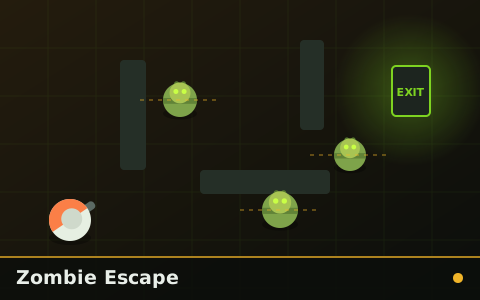
Zombie Escape
Find the exit, avoid the patrols, do not take the obvious route. Levels get denser, not bigger.
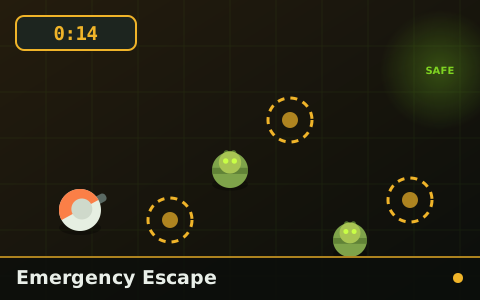
Emergency Escape
A countdown that only checkpoints can extend. Reach the safe zone or run out of clock trying.

Dead City Escape
A city block you cannot see all of, two keycards you have to find, and one exit that only opens with both.

Graveyard Escape
Side-on sprint through a stylised graveyard. Jump the headstones, duck the branches, reach the gate.