On this page
Cover is not protection here
Very few arcade zombie games have a cover system in the shooter sense — you cannot hide behind a crate and be safe. Obstacles block movement, not damage, and enemies path around them rather than being stopped by them.
That makes obstacles a movement tool, and a powerful one, but it means treating them as shields produces exactly the wrong behaviour: standing still behind something while a crowd walks around it.
Forcing corrections
The most valuable use of an obstacle is against a direct pursuer. Cutting close around a corner forces the pursuer to take the outside line and correct its heading repeatedly, and each correction costs it distance.
In Zombie Chase this is the entire counterplay to a pursuer that is faster than you. A straight line loses; a series of tight turns around obstacles holds off something significantly quicker.
Creating chokepoints
In games with free movement and scattered obstacles, positioning yourself so that a crowd must funnel through a gap converts a spread-out problem into a queued one.
This is one of the few situations where standing relatively still is correct, because the geometry is doing the work. It only holds while the chokepoint holds, so the moment enemies start flowing around the obstacle rather than through the gap, the position is spent.
Obstacles as timing markers
In escape and runner games, fixed objects make excellent timing references. 'Jump when the headstone passes the third fence post' is repeatable in a way that 'jump when it looks close' is not.
This is the most underused application of scenery in the entire genre, and it is free — every game with a scrolling background has usable landmarks.
When obstacles work against you
- They hide threats. Anything you cannot see is a threat arriving without warning.
- They create dead ends. An obstacle plus a wall is a corner.
- They slow your line. Routing around clutter costs seconds that matter in timed games.
- They break circling patterns. A cluttered arena forces tighter circles, which lets crowds close.
Obstacles as a movement multiplier
The value of an obstacle is not that it stops anything. It is that it costs a pursuer more than it costs you, and that difference compounds over a run.
Going around an obstacle costs you a small detour. It costs a direct pursuer the same detour plus a heading correction on each side of it. Chain three obstacles together and a pursuer that was gaining is now losing ground.
- Cut close. The tighter your line around the corner, the wider the pursuer's must be.
- Alternate sides. Going left around one and right around the next forces two corrections rather than one.
- Use clusters. Two obstacles close together are worth far more than two spread apart, because there is no straight section for the pursuer to recover on.
- Do not stop behind them. The value is entirely in the movement; a stationary player behind an obstacle is simply a stationary player.
When obstacles are working against you
The same geometry that helps against a pursuer hurts against a crowd, and knowing which situation you are in matters.
| Situation | Obstacles are | Because |
|---|---|---|
| Single fast pursuer | Strongly helpful | Every corner costs it a correction |
| Dense crowd | Harmful | They remove escape routes and hide threats |
| Sparse crowd | Neutral | Useful as landmarks, little else |
| Timed escape | Harmful | Every detour is priced in seconds |
| Defence | Helpful | They delay enemies before they reach the objective |
In a dense field, a cluttered area is functionally a set of small corners — each obstacle creating a pocket with limited exits. That is why Zombie Swarm has an entirely open arena: adding obstacles would make it unplayable rather than harder.
Obstacle use by game
Where obstacles exist on this site and what they are actually for in each case.
- Zombie Chase: the primary counterplay. Cutting close forces the pursuer onto the outside line, which is the only way to survive once it is faster than you.
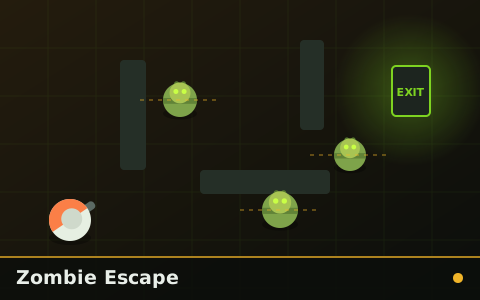
- Zombie Escape: route structure. They define the corridors, so reading them is reading the level.
- Dead City Escape: both navigation and hazard — buildings shape the streets and hide what is in them.
- Emergency Escape: pure cost. Every one you route around is seconds off a clock that is already insufficient.
- Rooftop Survivor: the ground itself. The gaps between them are the game.
Notably absent: the arena survival games. Zombie Rush and Zombie Swarm are deliberately empty, because at their crowd densities any obstacle becomes a pocket with limited exits.
The one legitimate use of an arena edge
Every other guide here tells you to stay off the edges, and that is right as a default. There is one situation where an edge is the correct position, and it is worth knowing because it is the exception that proves the rule.
When threats can only come from one direction. In Zombie Barricade the entire field is in front of you and your back is a wall by design — the wall is not a trap because nothing can use it. The same applies to the final stretch of a runner, or to a corner in Zombie Roadblock, where enemies travel in fixed lanes.
The test is simple: an edge costs you escape routes you would otherwise need. If nothing can approach from those directions anyway, the edge costs nothing and gives you a stable firing position with no rotation required.
- Safe to use an edge: single-direction threat, fixed lanes, or a defended objective behind you.
- Never safe: any arena where enemies spawn on all sides, which is most of them.
- The trap: a game that starts with single-direction threat and later adds flanking. That transition is exactly where edge habits become fatal, and it happens in several of the wave games.
Which is why the default advice is to stay central. The exception is real but narrow, and recognising when it stops applying is harder than simply not relying on it.
Key takeaways
- Obstacles block movement, not damage. Treating them as shields is a mistake.
- Cutting close around obstacles forces direct pursuers to correct, costing them distance.
- Chokepoints convert a spread crowd into a queue, but only while they hold.
- Fixed scenery makes excellent, repeatable timing markers.
- Clutter hides threats, creates dead ends and forces tighter circles.
- An obstacle's value is that it costs a pursuer more than it costs you — and only while you keep moving.
- Obstacles help against a single pursuer and hurt against a dense crowd.
- The arena survival games are deliberately obstacle-free because at high density every obstacle becomes a trap.
- An edge is safe only when nothing can approach from behind it — and games that later add flanking make that habit fatal.
Frequently asked questions
Can zombies path around obstacles?
Is it safe to stand behind a crate?
Which game uses obstacles most interestingly?
Why do some games have no obstacles at all?

Alex Morgan
Gaming Editor & Arcade Content Specialist
Alex Morgan is the editorial byline for everything published on Zombie Games Hub — game design notes, strategy guides and the tuning decisions behind all 30 arcade titles. More about our editorial byline.
Published · Last updated
Games mentioned in this guide

Zombie Chase
One zombie. It never stops, never loses you, and gets faster every checkpoint you reach.

Dead City Escape
A city block you cannot see all of, two keycards you have to find, and one exit that only opens with both.
Zombie Escape
Find the exit, avoid the patrols, do not take the obvious route. Levels get denser, not bigger.

Rooftop Survivor
Rooftop to rooftop above a flooded street. Variable gaps, variable heights, one jump button.