On this page
- What a zombie arcade game actually is
- The six types, and what each one actually tests
- How difficulty is supposed to work
- Choosing a game by what you want from it
- How to actually get better
- A short history of the form
- What separates a good arcade game from a bad one
- The vocabulary you will meet
- Where zombie arcade games fit alongside other browser games
- A realistic first week
- Why browser arcade games work now
What a zombie arcade game actually is
The phrase covers a surprisingly wide range of games, which is part of why searching for one is frustrating. A zombie arcade game is not defined by its subject matter — plenty of long, slow, story-driven zombie games exist and none of them belong in this category. It is defined by three structural properties.
- Short sessions. A run lasts between thirty seconds and roughly ten minutes. There is no save system because there is nothing long enough to need one.
- Immediate restart. Failure returns you to a playable state in about a second. The loop of attempt, fail, adjust and retry is the core experience.
- Score as progression. You do not unlock things. You get better, and the number goes up.
Everything else — whether you shoot, run, defend or dodge — is a variation inside those constraints. That is why a good zombie shooter and a good zombie runner feel more similar to each other than either feels to a full-length zombie action game.
The zombie theme itself does real work here beyond decoration. Zombies are slow individually and dangerous collectively, which is exactly the enemy profile arcade games need: readable one at a time, overwhelming in aggregate. A game built around fast, individually lethal enemies would be a different genre entirely.
The six types, and what each one actually tests
Every zombie arcade game sits in one of six broad families. They are not marketing categories — each one trains a genuinely different skill, and knowing which is which saves a lot of time.
| Type | Core skill | Session length | Good starting point |
|---|---|---|---|
| Shooters | Aim plus target priority | 3–8 min | Zombie Blaster |
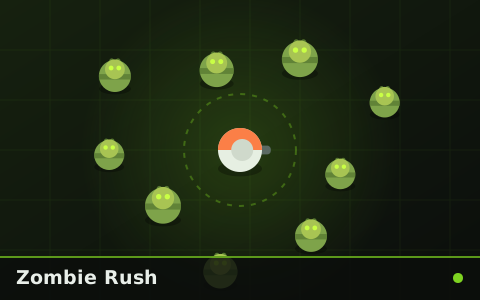
| Survival | Movement and spatial reading | 1–6 min | Zombie Rush |
| Defense | Threat triage under pressure | 4–10 min | Zombie Defense |
| Escape | Route planning | 1–4 min | Zombie Escape |
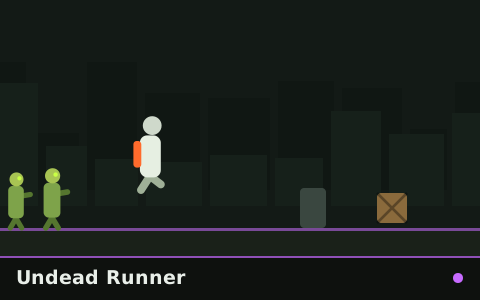
| Runner | Reaction speed and timing | 1–4 min | Undead Runner |
| Casual | One isolated mechanic | 30 s–3 min | Zombie Dodge |
Shooters
Shooters ask you to hit things and to choose which things to hit. The second half is where the difficulty lives. Almost every player can aim adequately within twenty minutes; almost nobody prioritises correctly without deliberate practice, because the intuitive choice — shoot the nearest thing — is wrong roughly a third of the time.
Survival
Survival games remove the ability to solve problems and leave you only with the ability to avoid them. This inverts a lot of instincts. In a shooter a zombie in front of you is an opportunity; in a survival game it is a wall. Players who come from shooters routinely spend their first several attempts trying to fight and dying to geometry.
Defense
Defense games attach you to an objective you cannot move. The central skill is ranking threats by their distance to that objective rather than to you, which is unintuitive enough that most players lose their first few rounds at full health, having never been touched.
Escape
Escape games are the only family with a genuine win state. They test route planning: not how fast you react but how good the line you committed to thirty metres ago was. They are also the most satisfying entry point for anyone who finds endless games discouraging.
Runners
Runners give you one decision at a time and shrink the window for making it. The whole category is a test of how quickly you convert what you see into an input, plus how far ahead you are willing to look.
Casual arcade
Casual games isolate a single mechanic and push it. They are the shortest to learn and frequently the hardest to master, because there is nothing else to blame a bad run on.
How difficulty is supposed to work
Every well-built arcade game follows the same difficulty shape, and recognising it helps you read a game quickly.
The first thirty seconds should be survivable by someone who has never played before. This is not generosity — it is information design. A player who dies in eight seconds has learned nothing except that the game is hard, whereas a player who survives thirty seconds has learned what the controls do, what the enemies look like and roughly how fast things move.
After that opening window, difficulty should rise on a curve that flattens rather than a line that climbs forever. A linear ramp guarantees that every run ends at approximately the same difficulty level regardless of skill, which makes improvement invisible. An asymptotic curve means a better player reaches a stable plateau and holds it, so the difference between a beginner and an expert shows up as minutes rather than seconds.
If a game gets harder in a straight line forever, your skill barely affects your score — everyone dies at roughly the same difficulty, just at different times. Look for games where a good run reaches a plateau. That plateau is where actual skill expression happens.
The third element is enemy introduction. New enemy types should appear on a schedule, not randomly, so a first-time player meets basic enemies first. Every game on this site introduces fast enemies at around twenty seconds and heavy enemies later still, for exactly this reason.
Choosing a game by what you want from it
The most common reason people bounce off arcade games is picking the wrong one for their mood, not for their skill.
- Two minutes, no thinking — casual arcade or a runner. Zombie Dodge or Zombie Sprint.
- Something to actually finish — escape. Graveyard Escape has a real gate to reach.
- A long session with a build to develop — Zombie Arena or Ultimate Zombie Arcade.
- Something to think about rather than react to — Zombie Roadblock has almost no reflex requirement.
- Pure mechanical practice — Zombie Target isolates aiming completely.
How to actually get better
Improvement in arcade games is unusually measurable, which makes it unusually easy to approach deliberately.
- Play five runs before judging anything. The first two attempts at any arcade game are learning, not performance. A verdict formed on attempt one is worthless.
- Change one thing per session. If you decide to look further ahead, do only that. Changing three habits at once makes it impossible to know which helped.
- Notice where runs end, not how they end. If most of your runs die at wave four, the problem is something specific to wave four, not general skill.
- Restart immediately after a loss. The pattern that killed you is still in working memory for a few seconds. That is the cheapest learning available.
The single most valuable habit across every game type is looking further ahead than feels necessary. In runners this means watching the far edge of the screen. In shooters it means tracking the zombie that will matter in three seconds rather than the one in front of you. In defense it means watching the objective's health bar rather than your own. It is the same skill wearing different clothes, and it is worth more than any amount of mechanical practice.
A short history of the form
Arcade games were shaped by a business model. A cabinet earned money per credit, so a run had to be short, failure had to feel like the player's fault, and the next attempt had to look winnable. Those three constraints produced the design grammar that browser arcade games still use fifty years later, long after the coin slot disappeared.
The zombie theme arrived much later, but it fitted the grammar unusually well. Arcade games need enemies that are individually readable and collectively overwhelming, that approach predictably enough to be learned, and that can appear in large numbers without becoming visual noise. A shambling crowd satisfies all three. A squad of tactical soldiers does not.
This is why the genre keeps producing new mechanics rather than reskins. Zombies can be slow or fast, dense or sparse, blockers or chasers, and each variation makes a genuinely different game while keeping the same visual language. Our own library has thirty distinct mechanics for exactly that reason.
The coin slot is gone, but the design it produced survived because it was good design, not because it was profitable.
What separates a good arcade game from a bad one
Genre conventions do not guarantee quality. Four properties reliably distinguish a game worth an hour from one worth two minutes, and all four are visible within a handful of attempts.
1. Failure is attributable
You should be able to name the mistake. Not necessarily instantly, but on reflection: 'I reloaded too late', 'I backed into a corner', 'I missed the runner'. When a death cannot be attributed to a decision, the game feels arbitrary regardless of how difficult it actually is — and arbitrary is the one thing an arcade game cannot survive.
The usual causes of unattributable failure are technical rather than philosophical: enemies spawning off-screen near the player, new enemy types appearing at random rather than on a schedule, instant-kill mechanics with no wind-up, or a resource that matters but has no visible meter.
2. The skill ceiling is much higher than the floor
If a very good player survives twice as long as a beginner, the game is not measuring much. In a well-tuned arcade game the ratio is closer to four or eight to one, which is what makes improvement feel worth pursuing. You can test this yourself in about ten minutes: play five attempts, note your first and best times, and see how far apart they are.
3. Restarting is instant
The gap between failing and playing again determines how many attempts you make, and the number of attempts determines whether you improve at all. A confirmation dialog, a score submission step or an unskippable animation between runs quietly destroys the loop.
4. The difficulty curve has a shape
Difficulty should rise, flatten and then hold, so a skilled player reaches a stable state rather than an inevitable wall. Games that escalate forever make everyone die at the same difficulty value, just at different times — which flattens skill into a stopwatch reading.
The vocabulary you will meet
A handful of terms appear constantly in arcade discussion and are worth knowing before you read any strategy advice. Our full glossary covers the rest.
| Term | What it means | Why it matters |
|---|---|---|
| Wave | A discrete group of enemies that must be cleared | Creates a rhythm and gives failure a label |
| Spawn window | The phase while enemies are still arriving | The cheapest time to act |
| Breather | The gap between waves | Free time for reloading and repositioning |
| Plateau | Where difficulty stops rising meaningfully | The point long runs actually live at |
| Kiting | Moving away from a slow enemy instead of killing it | The correct answer to heavy enemies |
| Time-to-contact | Seconds until an enemy reaches you | The correct basis for prioritising |
Two of these are worth internalising immediately. Kiting is the single most underused tactic among new players, who almost always try to kill a slow heavy enemy rather than simply walking away from it. And time-to-contact is the correction to the most common tactical error in the genre: shooting whatever is nearest.
Where zombie arcade games fit alongside other browser games
It is worth being clear about what this genre is not, because picking the wrong genre for your mood is the most common reason people bounce off browser games entirely.
- Puzzle games reward thinking without time pressure. If you want to solve something rather than react to it, Zombie Roadblock is the only game here that fits, and it is deliberately the exception.
- Idle and incremental games reward time invested. Arcade games explicitly do not — there is nothing to unlock and no progress bar that fills while you are away.
- Story games reward attention over hours. An arcade run lasts minutes and has no narrative to lose track of.
- Competitive multiplayer rewards you relative to other people. Arcade games measure you against yourself, which is either the appeal or the limitation depending on what you want.
The practical upshot: arcade games are the right choice when you have a short, uncertain amount of time and want something that starts instantly and can be abandoned mid-session without losing anything.
A realistic first week
If you are starting from nothing, here is what improvement actually looks like — not a training plan, just what most people experience.
- Day one. The controls occupy all your attention. Runs are short and feel chaotic. This is normal and it passes quickly.
- Day two or three. Movement becomes automatic and you start noticing individual enemies rather than a blur. Times roughly double.
- End of the first week. You recognise enemy types by shape and start prioritising without thinking about it. This is where the largest single jump happens.
- Second week. Progress appears to stop. It has not — you have hit your first plateau, which is a specific problem rather than a ceiling. Our guide on surviving increasing waves covers how to diagnose it in a single run.
- Beyond. Progress becomes step-shaped: long flat periods, then a sudden jump when a habit clicks. That pattern continues indefinitely and is completely normal.
If your times are not improving at all after ten or fifteen attempts at the same game, the problem is almost never effort. It is that you are repeating the same approach. Change one specific habit and measure again.
Why browser arcade games work now
For most of the web's life, a game like the ones on this site needed a plugin. Flash and Java applets carried browser gaming for a decade and then disappeared, and for a while the genre went with them.
Three things changed that, and they are worth knowing because they explain why a browser game today feels like a native one rather than a compromise.
- The canvas element. A single drawing surface with a full 2D API, available everywhere, with no plugin and no permission prompt. Everything visual in these thirty games is drawn into one canvas at run time.
requestAnimationFrame. A frame callback synchronised to the display's refresh, rather than a timer that fires whenever it feels like it. This is what makes smooth motion possible at all.- Genuinely fast JavaScript. Modern engines compile hot loops to machine code. A collision loop over a hundred entities is no longer the bottleneck it was in 2010.
What that means practically is that the constraint on a browser arcade game is no longer the browser. It is design discipline — and specifically restraint about what runs every frame. Our heaviest game redraws a full-canvas lighting gradient sixty times a second and still holds frame rate on a mid-range phone, because nothing else unnecessary is competing with it.
It also means the genre has no installation friction at all, which changes what it is good for. A game you can start in one second is a different proposition from one you download, and short-session arcade design suits that far better than long-form games do.
Key takeaways
- Zombie arcade games are defined by short sessions, instant restarts and score-based progression — not by their subject matter.
- Six families each train a different skill: aim, movement, triage, routing, reaction and single-mechanic mastery.
- Good difficulty curves flatten out; a curve that rises forever makes skill nearly invisible.
- Pick a game by the kind of session you want, not by how hard it looks.
- Looking further ahead is the highest-value habit in every category.
- Attributable failure, a high skill ceiling, instant restarts and a shaped difficulty curve separate good arcade games from bad ones.
- Kiting and time-to-contact are the two concepts that most quickly improve a new player's results.
- Canvas, requestAnimationFrame and fast JavaScript engines removed the plugin era's constraints — the limit now is design restraint, not the browser.
Frequently asked questions
Are zombie arcade games suitable for beginners?
Do I need to download anything?
What is the difference between an arcade zombie game and a full zombie game?
Which category should I try first?
How long should a single run last?
Do I need to be good at other games to enjoy these?

Alex Morgan
Gaming Editor & Arcade Content Specialist
Alex Morgan is the editorial byline for everything published on Zombie Games Hub — game design notes, strategy guides and the tuning decisions behind all 30 arcade titles. More about our editorial byline.
Published · Last updated
Games mentioned in this guide

Zombie Blaster
Top-down arena shooter with waves, reloads and a magazine that always runs dry at the worst moment.
Zombie Rush
No weapon, no cover, no plan but movement. Zombies come from every edge and only get faster.

Zombie Defense
A generator in the middle of the map, zombies that want it more than they want you, and one of you.
Undead Runner
Endless side-scrolling sprint. Jump, slide, grab supplies and keep ahead of a horde that never tires.